
Wheel alignment measures and adjusts wheel geometry relative to the vehicle and its specified reference. Wheel balancing corrects uneven mass distribution in a rotating wheel-and-tire assembly. They solve different problems, even though a vehicle can need both services at the same time.
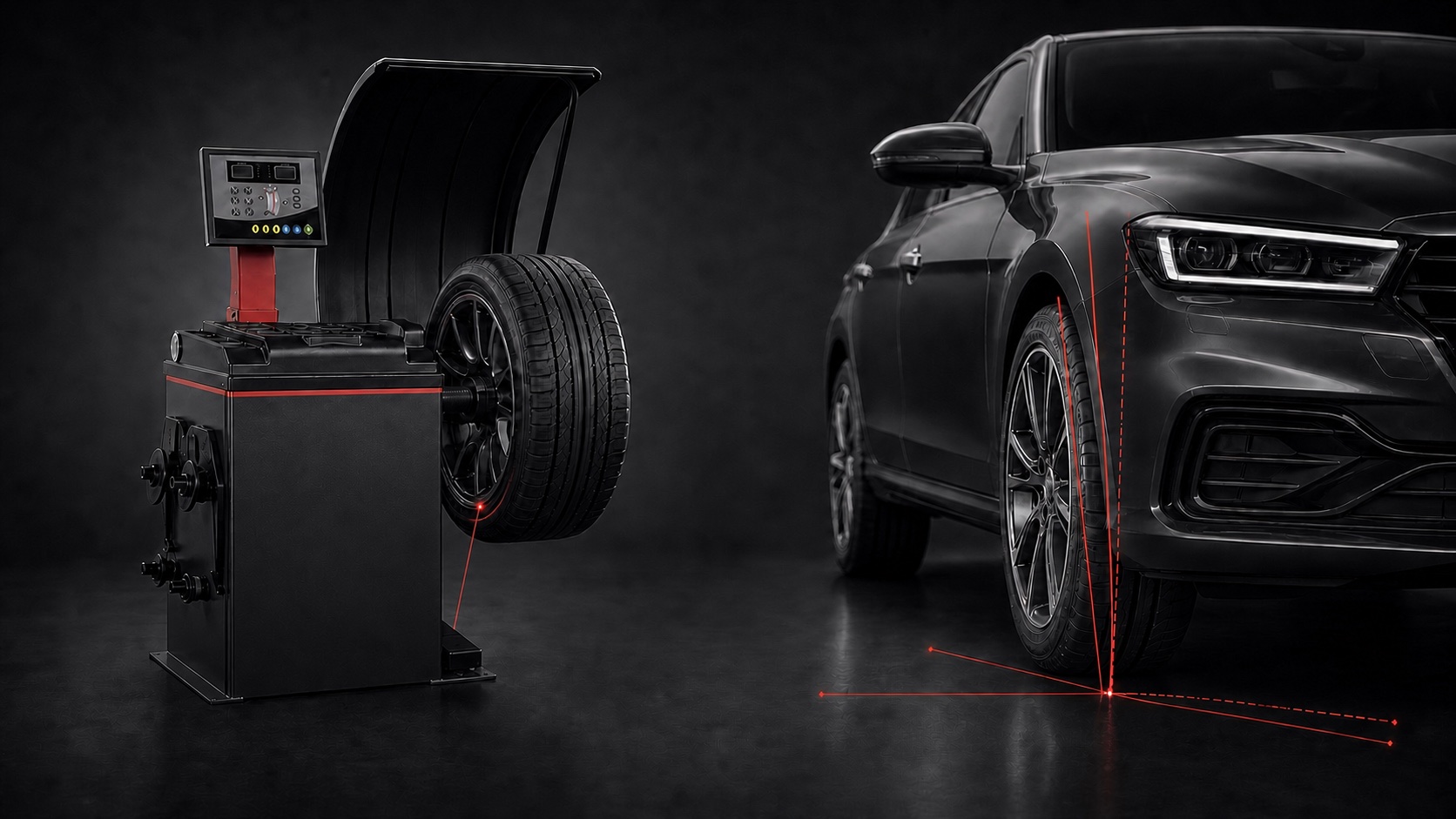
Checks toe, camber, caster, thrust and related vehicle geometry.
Locates and corrects heavy and light areas in the rotating assembly.
Vibration and irregular wear can have more than one cause.
Confirm the complaint before choosing a service.
The essential difference
An alignment system measures where the wheels point and how the wheel and steering axes relate to the vehicle. An adjustment brings serviceable angles into the current vehicle specification. A wheel balancer rotates the wheel-and-tire assembly, measures imbalance and shows where corrective weight is required.
Balancing cannot correct toe, camber or an off-center steering wheel. Alignment cannot correct an uneven mass distribution, tire or wheel runout, or a tire uniformity problem. Treating one service as a substitute for the other often leaves the original complaint unresolved.
Compare the symptoms
| Observation | Alignment-related possibilities | Balance or rotating-assembly possibilities | Important alternatives |
|---|---|---|---|
| Vehicle pulls or drifts | Toe relationship, camber, caster, thrust angle or steering centering. | Usually not caused by simple imbalance. | Road crown, tire conicity or force variation, pressure, brake drag and ride height. |
| Steering wheel is off-center | Toe split, thrust angle or an incomplete centering procedure. | Balancing does not normally change steering-wheel position. | Steering or suspension damage and shifted mounting points. |
| Speed-related vibration | Alignment alone is rarely the direct cause. | Wheel imbalance, mounting error, runout or tire uniformity. | Driveline, hub, bearing and suspension faults. |
| Irregular tire wear | Toe, camber, thrust and worn or moving suspension parts. | Imbalance or runout can contribute to some repeating wear patterns. | Inflation, damping, rotation history and tire construction. |
| Wandering or poor straight-line stability | Caster, toe, thrust, setback or geometry that changes under load. | Not a typical balance-only symptom. | Tires, steering free play, bushings, road surface and crosswind. |
Read tire wear carefully
Tire wear provides useful evidence, but several conditions can create similar patterns. Center wear commonly directs the inspection toward inflation and load. Wear on both shoulders can indicate underinflation or severe operating conditions. One-sided wear can involve camber, toe, ride height or moving suspension components. Feathering across tread blocks often supports a toe-related diagnosis.
Cupping or scalloping is not proof of imbalance. Inspect balance, radial and lateral runout, damping, looseness, inflation and tire condition together. Record the pattern and its location before rotating or replacing the tire.
A practical diagnostic workflow
- Road-test the vehicle with the customer complaint clearly defined, where safe and permitted.
- Inspect tire size, pressure, tread condition, damage and wheel mounting.
- Check wheel and tire runout, hub seating and visible mechanical defects.
- For speed-related vibration, measure balance and mounting accuracy before assuming an alignment fault.
- For pull, off-center steering, instability or alignment-type wear, complete the pre-alignment inspection and verify ride height.
- Measure all four wheels with the correct vehicle specification and loading condition.
- Correct verified mechanical, tire, balance and alignment conditions in a logical order.
A vehicle with several symptoms may require tire correction, balancing and alignment. The order should follow the evidence rather than a fixed sales package.
Verify the repair
After wheel service, confirm clean hub contact, correct centering and fastener installation. After alignment, recheck final readings and steering-wheel position. Finish with a road test on a suitable route and confirm that the original symptom changed as expected.
Frequently asked questions
Should wheels be balanced before an alignment?
Balance first when the main complaint is speed-related vibration or when wheel service is already required. Alignment measurement can proceed once the tires, wheels, bearings and suspension provide a reliable reference.
Can poor alignment cause vibration?
Alignment geometry alone is not the usual cause of a speed-specific vibration. It can contribute indirectly through tire wear or unstable components, so the complete tire, wheel and suspension system still requires inspection.
Will balancing straighten an off-center steering wheel?
No. An off-center steering wheel normally requires investigation of toe, thrust angle, centering procedure and steering or suspension condition.
Can a vehicle need both services?
Yes. Imbalance and incorrect alignment are independent conditions and can occur together.
TreadPlus technical learning reference · Published July 21, 2026. Diagnose the complete vehicle and use current service information.